

Neurostimulation Devices Market to reach USD 29.72 Billion by 2035 at 11.50% CAGR
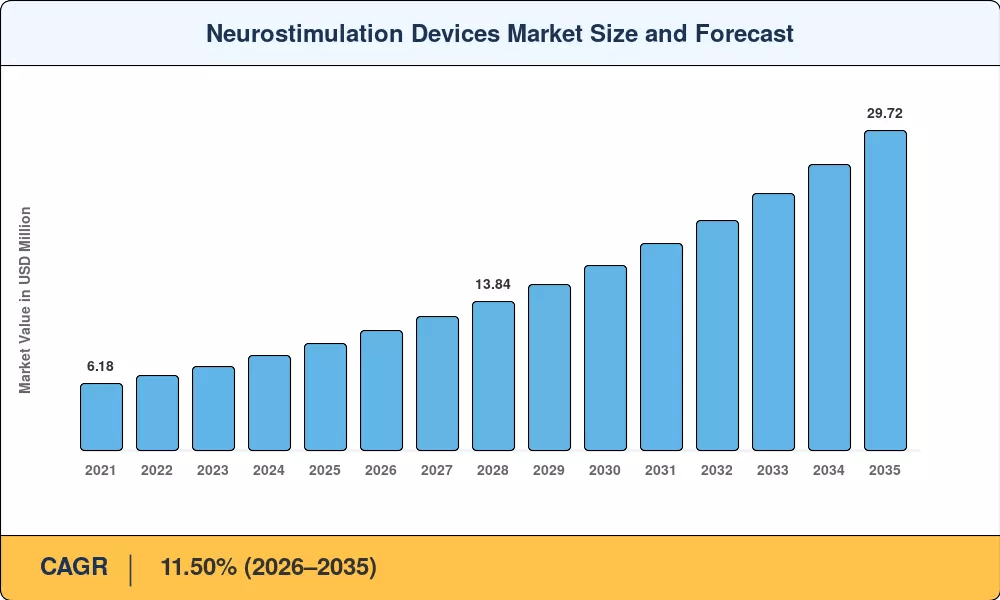
Neurostimulation Devices Market Size
Neurostimulation Devices Market to Surge from USD 11.13 Billion in 2026 to USD 29.72 Billion by 2035.
NY, CA, UNITED STATES, June 15, 2026 /EINPresswire.com/ -- As per Market Research Future, the global Neurostimulation Devices Market size to reach USD 29.72 Billion by 2035 from USD 11.13 Billion in 2026, at a CAGR of 11.50% during the forecast period 2026--2035. The market base was estimated at USD 9.98 Billion in 2025.The 11.50% CAGR---nearly double the growth rate of the broader medical device sector---is driven by three converging structural forces: the rising global prevalence of neurological disorders (WHO reports roughly 55 million dementia patients worldwide as of 2022, with nearly 10 million new cases diagnosed annually), the technological transformation from first-generation open-loop stimulators to closed-loop, AI-enabled implantable pulse generator systems capable of real-time biomarker sensing, and expanded reimbursement coverage for neuromodulation treatment procedures across North America and Europe converting device adoption from elective to standard-of-care.
National governments and health systems are amplifying this momentum. The U.S. Centers for Medicare & Medicaid Services (CMS) expanded its coverage determination for high-frequency spinal cord stimulator therapy in 2023, adding chronic pain nerve stimulation indications for failed back surgery syndrome and complex regional pain syndrome. Germany's G-BA similarly broadened statutory insurance coverage for deep brain stimulation in treatment-resistant depression.
The UK's NICE issued positive technology appraisals for high-frequency spinal cord stimulator therapy, while the NHS Long Term Plan earmarked substantial funding for neurological care. China's Healthy China 2030 initiative is funneling billions into tertiary hospital infrastructure, creating greenfield demand for deep brain stimulation and spinal cord stimulator therapy systems. India's Ayushman Bharat program and Production Linked Incentive (PLI) scheme for medical devices are expanding both patient access and domestic manufacturing capacity. Together, these initiatives are creating the reimbursement infrastructure and clinical adoption pathways on which neuromodulation treatment depends.
Request A Free Sample: https://www.marketresearchfuture.com/sample_request/2263
Key Market Trends & Growth Drivers
Rising Neurological Disease Prevalence
The market for neurostimulation devices is primarily driven by the prevalence of neurological illnesses worldwide. According to WHO figures, the incidence of Parkinson's disease has doubled over the last 25 years, affecting over 8.5 million individuals globally. In January 2023, almost 14,000 new dementia patients aged 65 and older were reported in England alone, according to NHS Primary Care Dementia Data.
Higher procedural volumes for deep brain stimulation and spinal cord stimulator therapy result directly from these epidemiological trends, maintaining baseline demand regardless of economic cycles. The International Association for the Study of Pain estimates that one in five adults globally experiences chronic pain, with opioid-alternative therapies gaining regulatory preference, positioning spinal cord stimulator therapy and peripheral nerve stimulation as frontline neuromodulation treatment options.
Closed-Loop and AI-Enabled Device Innovation
Adaptive neurostimulation---where the implantable pulse generator adjusts output in real time based on neural biomarkers---represents a paradigm shift from static, clinician-programmed protocols. Medtronic's Percept PC platform and Abbott's proprietary sensing algorithms have demonstrated 30--40% improvement in symptom control for Parkinson's patients compared to open-loop devices. This performance gap is accelerating physician adoption and creating premium pricing power across the Neurostimulation Devices Market.
The global pipeline for next-generation spinal cord stimulator therapy platforms alone attracted over USD 1.2 billion in venture and strategic capital between 2022 and 2024, underscoring investor confidence in adaptive neuromodulation treatment technologies. By 2030, an estimated 60% of newly implanted deep brain stimulation systems will feature embedded machine learning algorithms.
Expanded Reimbursement and Regulatory Fast-Track Approvals
CMS expanded its coverage determination for high-frequency spinal cord stimulator therapy in 2023, adding chronic pain nerve stimulation indications for failed back surgery syndrome and complex regional pain syndrome. Germany's G-BA broadened statutory insurance coverage for deep brain stimulation in treatment-resistant depression. These policy decisions reduce patient out-of-pocket exposure and shorten sales cycles for device manufacturers.
FDA breakthrough therapy designations for responsive neurostimulation in obsessive-compulsive disorder and treatment-resistant depression are expanding the market well beyond traditional pain and movement disorder applications. Clinical trials at major academic centers have demonstrated 50--60% response rates for deep brain stimulation in severe depression, potentially opening a multi-billion-dollar addressable market by 2030.
Market Segment Insights
BY DEVICE TYPE
Implantable Devices: Dominant segment with ~64% share in 2025. Driven by strong demand for rechargeable implantable pulse generator platforms in chronic pain nerve stimulation and movement disorder indications. Rechargeable models are gaining share as patients prefer longer device lifespans---Abbott's Proclaim XR platform offers up to 10 years of battery life, reducing revision surgery frequency. Medtronic's SenSight directional lead system and Intellis SCS platform reinforce market leadership.
External Devices: Fastest-growing segment at 13.2% CAGR (2026--2035). Propelled by non-invasive vagus nerve and transcranial stimulation platforms gaining regulatory clearance across multiple geographies. Transcranial direct current stimulation (tDCS) and non-invasive vagus nerve stimulation devices are unlocking outpatient and at-home treatment channels previously inaccessible to the market. ElectroCore's gammaCore Sapphire nVNS device received European commercialization clearance in late 2022, signaling regulatory readiness for prescription-grade home-use neuromodulation treatment devices.
BY APPLICATION
Pain Management: Dominant application with USD 3.49 Billion in 2025. Reflecting a global shift toward non-pharmacological chronic pain nerve stimulation approaches. Regulatory agencies in the US and EU have explicitly prioritized spinal cord stimulator therapy as a preferred alternative to long-term opioid prescriptions, creating institutional tailwinds. The American Society of Anesthesiologists' updated clinical guidelines directly expand the addressable patient population.
Parkinson's Disease: 12.1% CAGR (2026--2035). Broader clinical guidelines endorsing deep brain stimulation as a standard-of-care intervention. Over 200,000 patients implanted globally, with clinical evidence supporting earlier intervention in the disease course. Medtronic's Percept PC and Abbott's Infinity DBS platforms lead this segment.
Depression: Fastest-growing application at 14.7% CAGR. FDA breakthrough therapy designations for responsive neurostimulation in treatment-resistant depression and obsessive-compulsive disorder are expanding the market into psychiatric indications. Clinical trials demonstrate 50--60% response rates for deep brain stimulation in severe depression, potentially opening a multi-billion-dollar addressable market by 2030.
Epilepsy: ~14% market share. Responsive neurostimulation device approvals and expanding pediatric indications drive demand. NeuroPace's RNS System leads with closed-loop seizure detection and responsive stimulation.
Other Applications (Dystonia, Overactive Bladder, Tinnitus, Obesity): Combined ~8% share. Dystonia contributes USD 0.42 Billion (2025) with expanding pediatric indications. Axonics Inc. leads sacral neuromodulation for overactive bladder and pelvic floor disorders.
BY END USER
Hospitals: Dominant segment at ~58% share in 2025. Deep brain stimulation and complex spinal cord stimulator therapy procedures require inpatient surgical suites and neuroimaging capabilities. Academic medical centers perform the highest volumes of implantable pulse generator procedures.
Specialty Clinics: Fastest-growing end user at 12.8% CAGR. Outpatient neuromodulation treatment adoption benefits from the rise of external neurostimulation devices and same-day implant procedures for peripheral nerve stimulation. Pain management and movement disorder clinics are expanding device programming and chronic pain nerve stimulation management capabilities.
Home Care Settings: Emerging segment at ~9% share. The pandemic permanently shifted patient expectations toward home-based care. Non-invasive vagus nerve stimulation and transcranial devices designed for unsupervised home use represent a largely untapped channel. Regulatory pathways for prescription-grade home-use neuromodulation treatment are maturing in both the US and EU.
Ask for Customization: https://www.marketresearchfuture.com/ask_for_customize/2263
Regional Outlook
North America --- Dominant Market (~41% Share, 2025)
The United States generates approximately 83% of North American Neurostimulation Devices Market revenue, supported by broad commercial payer coverage, a dense network of academic medical centers performing deep brain stimulation procedures, and CMS reimbursement updates in 2023 that expanded eligible indications for chronic pain nerve stimulation. The FDA's breakthrough therapy designations for responsive neurostimulation in psychiatric indications directly broaden the insured patient funnel. Canada is accelerating at 10.9% CAGR on provincial coverage for implantable pulse generator systems. Mexico's private healthcare sector is investing in neurostimulation-capable surgical suites, contributing USD 0.14 Billion (2025). North America's leadership rests on reimbursement depth, procedural volume, and regulatory innovation.
Europe --- Second Largest (~28% Share, 2025)
Europe's Neurostimulation Devices Market benefits from centralized health technology assessment bodies that, once favorable, unlock large patient populations simultaneously. Germany leads regionally with ~24% of European share, as its G-BA expanded statutory coverage for deep brain stimulation across multiple indications in 2023. The UK is growing at 11.6% CAGR anchored by NICE positive appraisals for high-frequency spinal cord stimulator therapy. France's hospital budget reforms supporting implantable devices contribute USD 0.41 Billion (2025). Italy's growing chronic pain nerve stimulation volumes and Spain's national neurology care plan investments at 10.8% CAGR further underpin European market depth. The Nordic countries lead digital health integration with neurostimulators at ~8% of regional share. EU cross-border reimbursement harmonization supports the rest of Europe at 10.2% CAGR.
Asia-Pacific --- Fastest-Growing Region (13.8% CAGR, 2026--2035)
Asia-Pacific is the highest-growth corridor in the Neurostimulation Devices Market. China commands ~35% of regional share, with the implantable pulse generator market scaling rapidly as domestic manufacturers enter the space with competitively priced deep brain stimulation systems under the Healthy China 2030 initiative. India is growing at 15.1% CAGR, the fastest country-level pace, driven by Ayushman Bharat infrastructure expansion and the PLI scheme for medical devices that could reduce implantable pulse generator costs by 15--20%. Japan contributes USD 0.38 Billion (2025) through super-aging society rehabilitation demand and advanced neuromodulation treatment adoption. South Korea's national health insurance coverage expansion accounts for ~12% of regional share. ASEAN medical tourism and private hospital investments are growing at 13.6% CAGR. China and India collectively account for over 60% of regional demand.
Middle East & Africa --- Emerging Opportunity (10.4% CAGR, 2026--2035)
Saudi Arabia leads the region with ~31% of regional share, as Vision 2030 channels substantial investment into specialized neurological care centers, making it the regional anchor for the Neurostimulation Devices Market. The UAE attracts medical tourism patients seeking advanced deep brain stimulation procedures, growing at 11.8% CAGR. South Africa's academic hospitals serve as training hubs for neuromodulation treatment across the continent, contributing USD 0.06 Billion (2025).
Egypt's government hospital modernization is growing at 10.1% CAGR. NGO-funded neurosurgery programs support access across the rest of the region. The WHO estimates fewer than 0.5 functional neurosurgeons per 100,000 people in Sub-Saharan Africa, highlighting both the access gap and the long-term growth potential.
South America --- Growing Presence (USD 0.52 Billion, 2025)
Brazil anchors South America's Neurostimulation Devices Market at ~58% of regional revenue, with the Unified Health System (SUS) increasingly covering deep brain stimulation for Parkinson's disease patients. Private hospital networks in São Paulo and Buenos Aires are investing in chronic pain nerve stimulation programs. Argentina's private hospital chain expansion is growing at 10.3% CAGR.
Reimbursement remains fragmented across the continent, with most emerging economies lacking specific DRG codes for spinal cord stimulator therapy procedures, forcing providers to seek case-by-case authorization. Brazil's SUS system covers select indications, but average approval timelines exceed six months.
Read Detailed Insights: https://www.marketresearchfuture.com/reports/neurostimulation-devices-market-2263
Competitive Landscape and Recent Developments
The Neurostimulation Devices Market exhibits low concentration, with an estimated HHI below 1,500 and the top five players collectively holding approximately 55--62% of global revenue. Competition is intensifying as traditional device incumbents face challenges from bioelectronic medicine startups and diversified medtech conglomerates expanding into neuromodulation treatment.
The competitive landscape is stratified between large diversified medtech conglomerates controlling broad implantable pulse generator portfolios, mid-sized pure-play neurostimulation firms focused on specific indications, and emerging bioelectronic medicine companies reshaping therapy delivery through non-invasive and closed-loop platforms.
KEY COMPANIES AND RECENT MILESTONES
Medtronic plc (August 2022): Launched the SenSight directional lead system for deep brain stimulation therapy in India, expanding access to precision neuromodulation treatment in one of Asia-Pacific's largest markets. Estimated revenue share: ~18--22% of global Neurostimulation Devices Market. Broadest implantable pulse generator portfolio with global distribution; Percept PC platform leads closed-loop adaptive stimulation.
Boston Scientific Corp.: Estimated revenue share ~14--17%. WaveWriter Alpha SCS and Vercise DBS platforms lead in closed-loop spinal cord stimulator therapy. Long-term clinical data demonstrating sustained pain relief reinforces evidence-based adoption. Full-body MRI compatibility differentiates from legacy systems.
Abbott Laboratories: Estimated revenue share ~12--15%. Proclaim XR SCS offers up to 10 years of battery life; Infinity DBS platform features burstDR stimulation technology differentiation. Sensing algorithms demonstrate 30--40% improvement in symptom control for Parkinson's patients compared to open-loop devices.
Nevro Corp. (September 2023): Published long-term clinical data demonstrating sustained pain relief at five years for its HFX iQ high-frequency spinal cord stimulator therapy, reinforcing evidence-based adoption. Estimated revenue share: ~5--8%. High-frequency chronic pain nerve stimulation specialist with proprietary 10 kHz waveform technology.
Future Outlook: 2026--2035
By 2030, AI-driven adaptive stimulation will become the operating standard for neuromodulation treatment. An estimated 60% of newly implanted deep brain stimulation systems will feature embedded machine learning algorithms that autonomously titrate stimulation parameters based on real-time neural recordings. This shift from clinician-dependent programming to patient-adaptive therapy will improve outcomes and reduce follow-up visit burden. Closed-loop systems have already demonstrated 30--40% greater symptom reduction and 45% less stimulation-induced side effects compared to conventional open-loop devices in randomized trials, driving clinical preference shifts globally.
Platform economics and software-defined therapy will reframe market monetization. The transition from hardware-centric to software-defined neurostimulation is creating recurring revenue streams as manufacturers charge for algorithm updates, indication expansions, and remote programming services. Boston Scientific and Medtronic are already piloting subscription-based neuromodulation treatment platforms that unlock new stimulation programs through over-the-air updates, mirroring the platform economics seen in cardiac rhythm management. By 2030, an estimated 40% of device revenue will come from software and services rather than one-time hardware sales.
More Related Research Insights:
https://www.marketresearchfuture.com/reports/neuromodulation-devices-market-1337
https://www.marketresearchfuture.com/reports/spinal-cord-stimulator-market-8782
https://www.marketresearchfuture.com/reports/neurorehabilitation-devices-market-2210
https://www.marketresearchfuture.com/reports/pain-management-market-5975
https://www.marketresearchfuture.com/reports/parkinsons-disease-therapeutics-market-1572
https://www.marketresearchfuture.com/reports/epilepsy-devices-market-10427
https://www.marketresearchfuture.com/reports/brain-monitoring-market-2288
https://www.marketresearchfuture.com/reports/medical-electrode-market-27634
https://www.marketresearchfuture.com/reports/active-implantable-medical-devices-market-8834
Larry Wilson
WantStats Research And Media Pvt. Ltd.
+1 855-661-4441
email us here
Visit us on social media:
LinkedIn
Facebook
YouTube
X
Legal Disclaimer:
EIN Presswire provides this news content "as is" without warranty of any kind. We do not accept any responsibility or liability for the accuracy, content, images, videos, licenses, completeness, legality, or reliability of the information contained in this article. If you have any complaints or copyright issues related to this article, kindly contact the author above.
